


BarTestingKit GAX1000
Bar testing - whenever high values are at stake.
The Goldanalytix bar testing kit enables the testing of large gold, silver or palladium bars with a weight of 100 g or more. The combined density and ultrasound testing allows both underalloyed materials and foreign metal inclusions in precious metal bars or coin bars to be detected safely and reliably. The ultrasonic testing is effective for materials of similar density (such as tungsten in gold) and the density determination is successful for under-alloyed materials of deviating density. With the Goldanalytix bar testing kit several forgeries have already been detected !
Advantages & features of the Goldanalytix bar testing kit
Reliable detection of foreign metals in precious metals
Density determination to determine the alloy
Especially suitable for bars from 100 g
Also suitable for coins and small bars
Prevents the purchase of counterfeit bars


Frequently asked questions about the BarTestingKit GAX1000
If you cannot find your question here, please use the contact form or send us an enquiry directly to gold-analytix@marawe.eu.
This depends entirely on which objects you want to check:
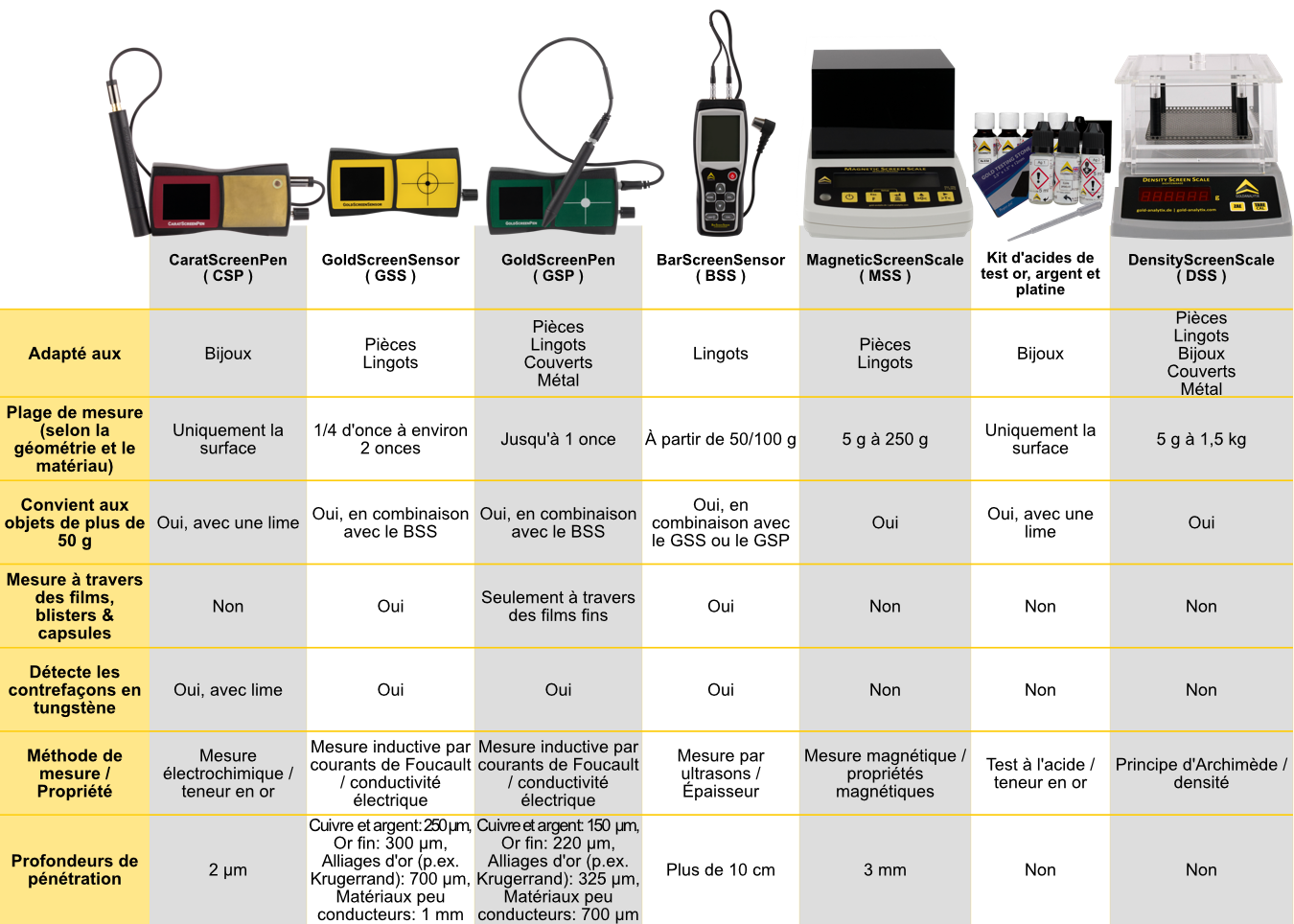
For classic investors (coins and bars), the GoldScreenSensor (also measures through packaging) in combination with a caliper and precision scale is usually sufficient . For bars from 50 to 100 grams upwards, we also recommend the BarScreenSensor, for which the objects must be unpacked. The GoldScreenPen can also be used for smaller investment objects up to approx. 1 ounce.
For gold jewellery, measurement with a combination of CaratScreenPen and DensityScreenScale is ideal. The fineness of gold (carat number) can also be determined with our test acid sets.
As a tungsten detector, the MagneticScreenScale is an alternative to the GoldScreenSensor for gold objects from approx. 1/4 ounce to 250 g. This MagneticScreenScale is a good choice for those who want to focus entirely on gold and do not want to unpack 100 gram bars, for example.
When measuring with the BarScreenSensor, it is important to remove the packaging of the object and apply the ultrasound gel to the measuring head. The measuring head must be in direct contact with the test piece.
It is also necessary to scan the entire ingot. It is possible that foreign metal inclusions can only be found at certain points within the object. In addition, the ingot should be physically measured beforehand so that the measured ultrasonic value can be compared with the real thickness.
Furthermore, it is important to pay attention to the size/thickness of the object. If it is too thin, the BarScreenSensor could give wrong results. Therefore, please use the BarScreenSensor only for bars of 50 to 100 grams or more. In addition, you should use at least one other measuring method (e.g. digital caliper and precision scale).
The smaller the bar to be tested, the more embossing and stamps in the gold/silver have an effect on the measurement result.
- With experience it takes about 30 seconds to take a measurement and calculate the result.
- Make sure that the scale is located as steady and vibration-proof as possible.
- Ideally, start the device 5-10 minutes before you use it so that it can regulate itself.
- The density scale works most reliably in a stable environment with a room temperature of 20-25 °C. The most important thing is that the temperature remains constant during the time of operation or use.
- Also note that you cannot use the density scale to measure jewellery set with precious stones, as stones falsify the density. Also, do not weigh any substances that react with water, e.g. sodium or potassium, or have a water-soluble layer.
- The test specimen must be dry and clean.
- Remove any capsules and blisters before measuring, otherwise the result will be inconclusive.
- With weakly wetting liquids (e.g. normal water), air bubbles may accumulate on the carrier or the test piece. An air bubble with a diameter of 2 mm already causes a measurement inaccuracy of 4 mg.
The density scale only indicates the weight of the test piece in the water. To calculate the density, you need the normal weight of the piece and the weight of the object in the water. To free you from having to do your own calculations, we provide you with our Excel calculation tool, which does the maths for you. Simply enter your measured values and the density of your piece is calculated.
Basically, density can be calculated by dividing the mass of an object by its volume.
If you have the DensityScreenScale or the bar testing set GAX1000, then you can use our calculation tool for this. To do this, measure the weight in air and the weight in water with the density scale. You can enter these two values into the tool and it will give you the density. In addition, with the calculation tool you have comparative values of some alloys and many pure metals.
If you want to calculate the density yourself, the formula is:
Density [g/cm³] = Air value [g] / (Air value [g] - Water value [g])
The measuring range of the density scale goes from 0.01 - 2000 grams. This means you can measure small objects as well as bars up to a weight of 2 kg.
Caution: With silver bars over 1 kilogram, the measuring basket may not be large enough, as silver has a lower density than gold and is therefore larger for the same weight.