Gold forging - a thousands of years old problem
Already in antiquity, there have been reports of various gold forgeries. A problem that hasn’t yet ceased to exist until modern times... The forgers’ tricks and strategies to trick people into buying them have gotten more and more refined and elaborated.
The fascination of gold
The precious metal gold has been accepted by humans as a valuable medium of exchange and payment for thousands of years. On the one hand, it is comparatively rare and, on the other hand, its characteristic yellow colour makes it easy to distinguish from other metals. In addition to its rarity, gold has some unique physical properties, such as high conductivity and very high density. Due to its high value, gold has almost inevitably become the focus of counterfeiters and fraudsters.
For several years now, the number of counterfeits has been rising rapidly as more and more people lose confidence in paper currencies as a result of the financial market crisis and invest in physical assets such as precious metals. This has led to a huge increase in the price of precious metals. This price increase and the global explosion in demand for precious metals have also led to a dramatic rise in counterfeiting attempts and fraud.
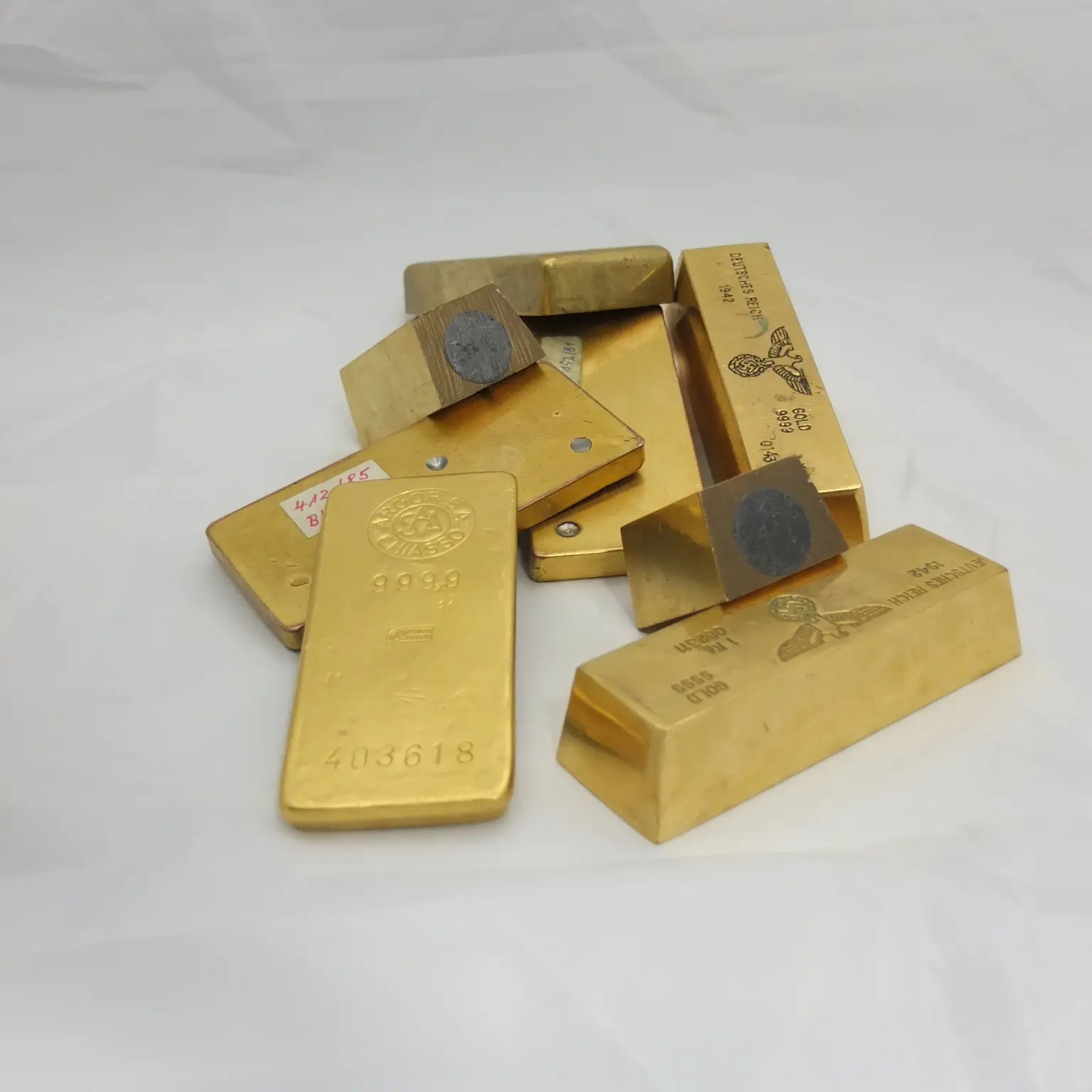
The range of counterfeits extends from relatively ‘clumsy’ gold bars with copper cores or fake gold coins of the lowest quality to highly professional counterfeit gold coins and gold bars with cores made of tungsten or tungsten alloy, which are indistinguishable from the originals in appearance, weight and minting (as, for example, those that came into circulation in Cologne in 2022).
Gold forging - no legend!
„Forged gold ingots are no legend. I myself have already seen a very well made falsification of a 1000g fine gold ingot.“ (Marcus Fasching, manager of Ögussa gold refinery)
Overall view of typical gold forging:
Cores made of low density material
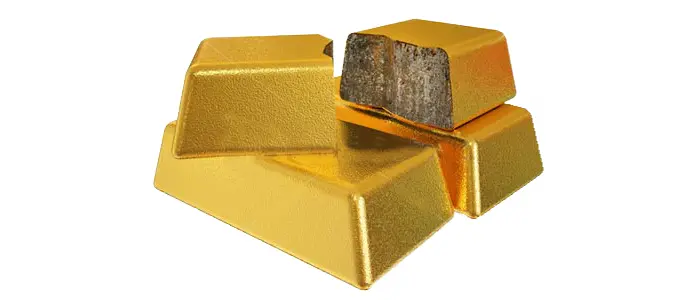
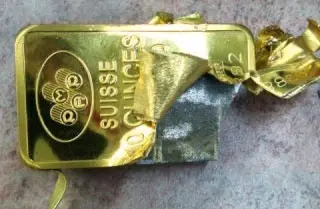
Then and now, it has always been one of the most frequent gold forgeries – some material like brass, lead, iron, copper or bronze is covered with gold. Either they use a thick gold layer that is then hallmarked or an already made ingot made of foreign metal is electroplated with a thin gold layer (a few µm).
Such falsifications are immediately detectable because the measurements are significantly higher with the same weight or the weight is significantly lower with the same measurements. Despite of that, such fraud objects still are successfully sold to trusting buyers (see “known cases of forged precious metals”).
It is more difficult to detect cases when they are uneven, geometrically complicated objects. In such cases, you can’t turn to tabulated standard measurements and weights – some examples are frames, gold figurines and statues, medals, badges, artistic objects and ornaments. Ideally, you turn to density scales to know the density in these cases in order to find out whether it can be the specific weight or pure gold or not.
Core material with a similar density to gold
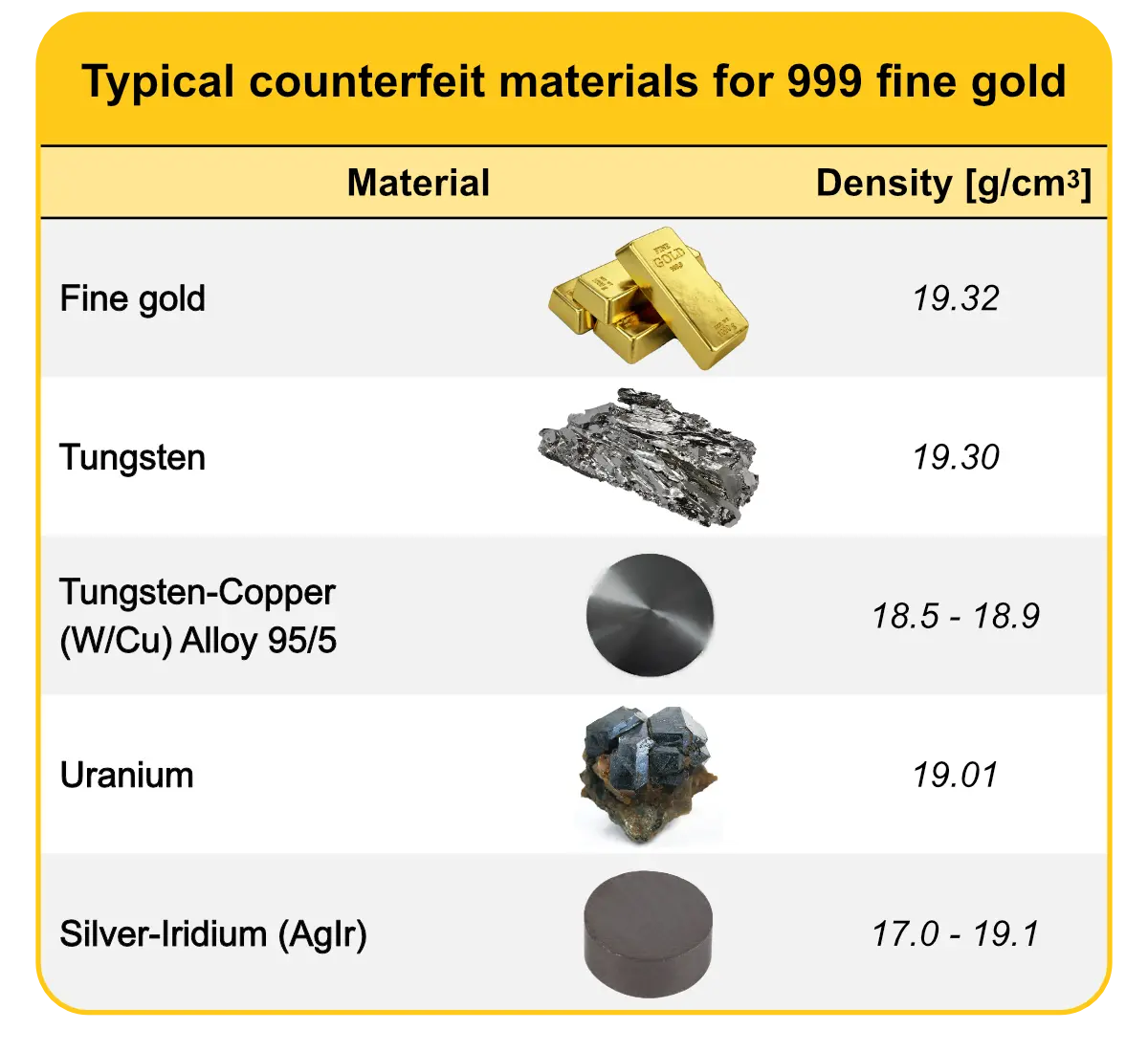
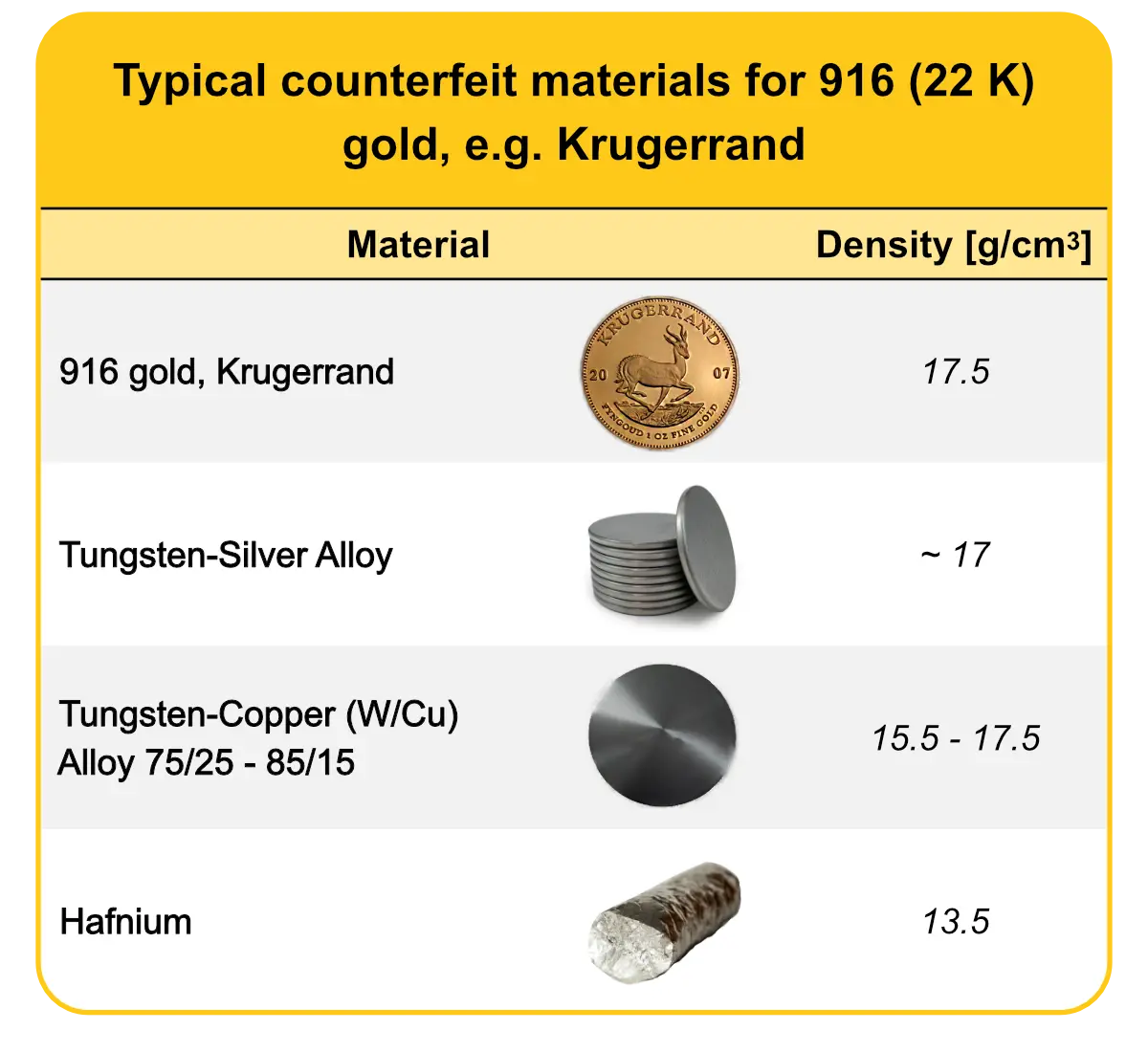
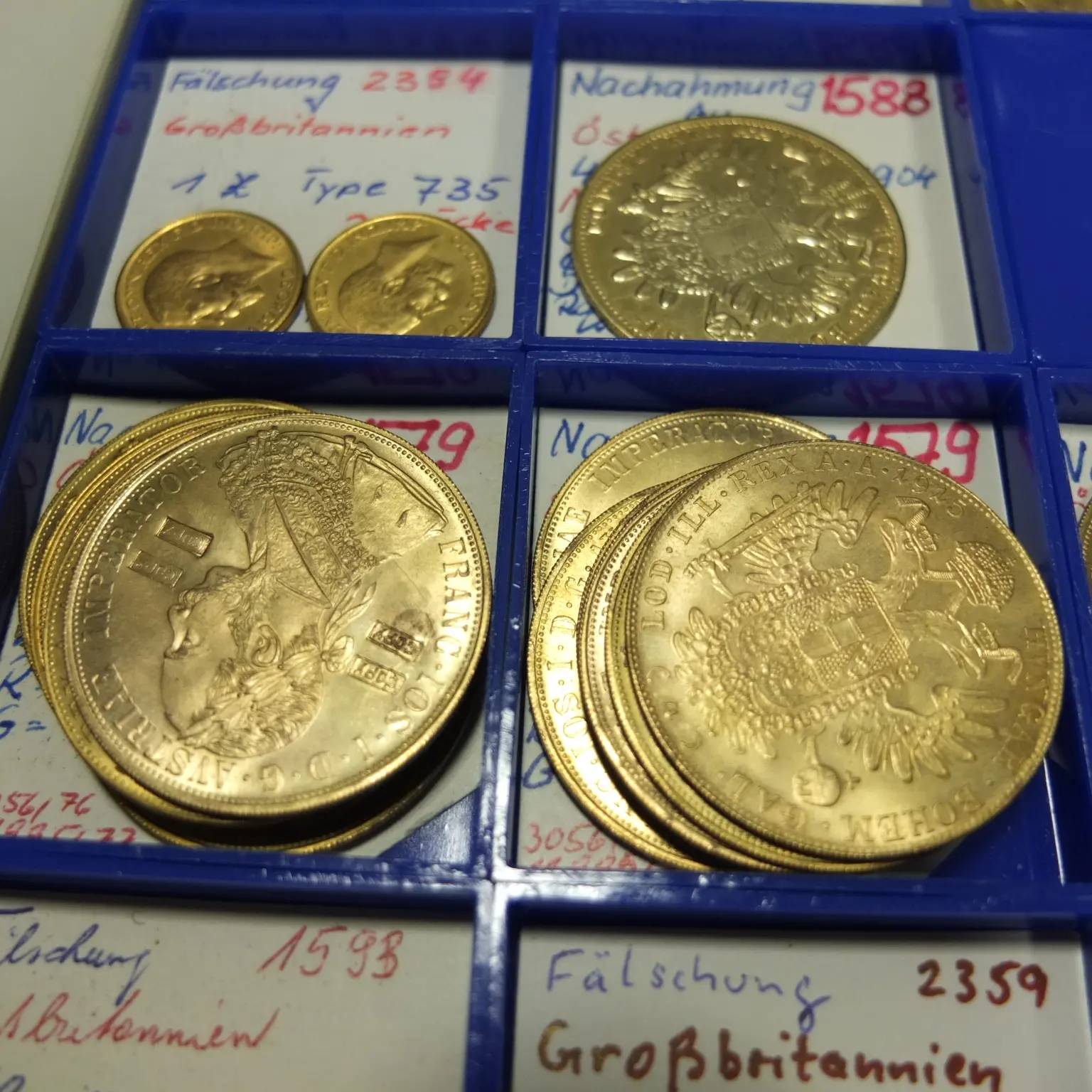
The preferred materials for these sometimes very skilful counterfeits can be divided into two categories, depending on whether they are pure gold or 916 gold (e.g. Krugerrand), as shown in the tables on the left. Tungsten most commonly appears inside bars or coins, as it has almost the same density as gold. This means that the weight and dimensions of the counterfeit original bars or coins can be imitated exactly. Since 2014, there has been a sharp increase in the number of these types of counterfeits in Germany: these are often counterfeit 1-ounce gold coins (e.g. fake American Eagles, counterfeit Krugerrand coins, etc.) and smaller gold bars, primarily counterfeit Perth Mint Kangaroo gold bars. The latter appears in both green and black blister packs. There are the slightly easier to recognise variants with only a brass or copper core and the more dangerous variant with a tungsten core, which also has the exact weight.
Detecting this type of counterfeit is impossible without invasive methods. In some cases, the sound can be used to distinguish between real gold and fake gold. However, this only works with thin layers of external gold plating and only if the tungsten material is sintered and not cast. This makes these types of counterfeits some of the most dangerous on the market. You can detect such coin counterfeits with our magnetic scale, for example. For larger bars, the Goldanalytix Bar Testing Kit is suitable for detecting inclusions.