

Not only gold is traded and valued worldwide as an investment and industrial metal - the precious metal silver also has a high priority in the international commodity trade due to its unique properties. How can you test silver for authenticity? The fact is that there are a large number of counterfeits and imitations of silver in circulation.
The following is about performing the silver test for silver coins, silver bars and jewelry made from silver and silver alloys. The procedure is basically identical to the gold test, but there are some special features that are highlighted here.
Silver & Silver Counterfeits - General Information
Silver coins and silver bars have gained a high status as investment objects, especially in recent years. So that the investment in physical silver really becomes a safe investment, we show you how to recognize real silver and avoid buying fake silver. Because even if the price per ounce of silver is lower than that of gold, counterfeiters have already smuggled numerous precisely manufactured imitations into the market. Often silver is "stretched" with the metals molybdenum, lead, tin-lead alloys or copper. Of course, alloys of these or other metals also occur in various combinations.
Counterfeits made of molybdenum and certain tin-lead alloys are particularly dangerous because these materials have almost the same density as silver. In this way, the counterfeiters can perfectly imitate the weight and dimensions. The counterfeit silver coins produced this way require examination using modern test methods such as the GoldScreenSensor. The eddy current measurement, the technology the GoldScreenSensor is based on, is particularly suitable for silver: pure silver has the highest conductivity of all metals. Therefore, with the GoldScreenSensor there is no risk of confusion with silver bullion coins (Ag 999 or 9999) with other counterfeit materials.
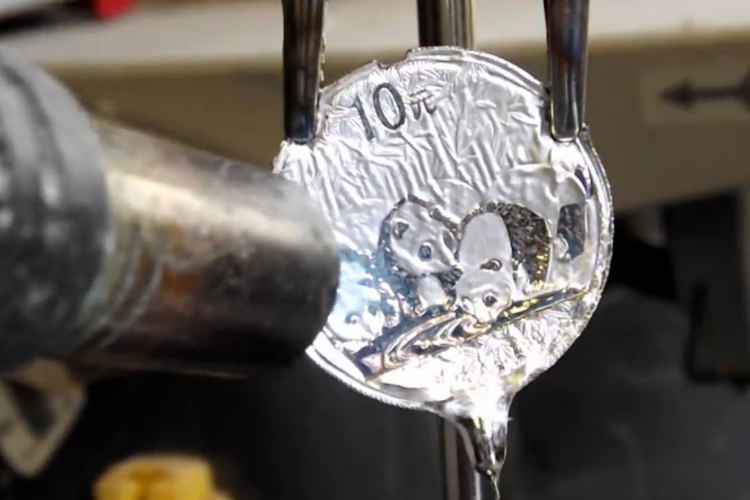
In the following example (see below) it`s possible to see an almost perfectly counterfeit 1 ounce China Panda silver coin with a core made of lead-tin alloy of the same density. The coin has almost exactly the dimensions and weight of the original coin. However, since the melting point of such alloys is far below that of pure silver, a hot air blower can melt the coin (on the right).

Visual inspection and examination of hallmarks and stamps
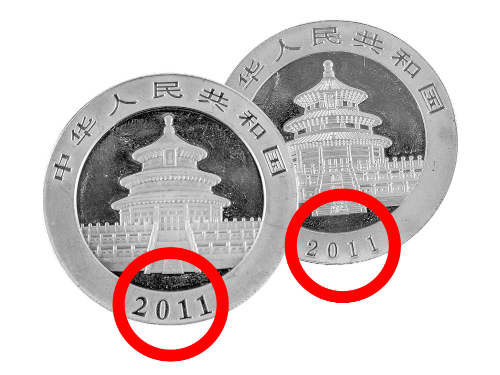
A first, simple silver test is the hallmark comparison of coins or bars with product images of the manufacturer (here the original on the left, the forgery on the right). Are the proportions correct, does the embossing depth appear like the originals, are all elements present? These and other questions about the details of silver coins and bars can provide initial indications of the existence of a silver counterfeit. Particularly important: should the object have corrugated or smooth knurling? With the help of a magnifying glass, you can also examine finer details in the coin image. In the case of forgeries, it often happens that the fine details of the embossed image were not exactly reproduced. Of course, you have to know the characteristics exactly. Keep in mind, however, that counterfeiters are always evolving their replicas and should therefore not be relied on by this method alone.
Test for correct weight and dimensions
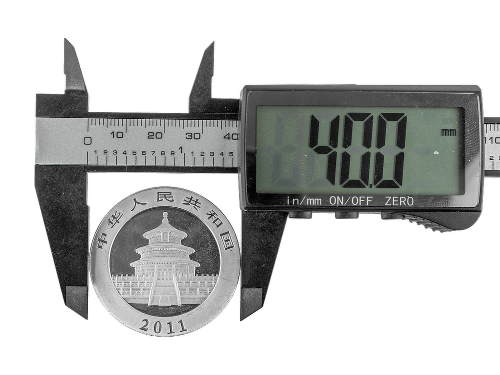
Another very simple method for testing silver is to determine the weight with a precision scale. For example an ounce of fine silver must not weigh significantly more or less than 31.1 grams. You can also use a digital caliper to determine the correct dimensions (thickness and diameter) of silver coins. The exact setpoints can be found in our rubric "Coin Dimensions & Weights", on the websites of the manufacturers and at refineries.
Determining the density of silver
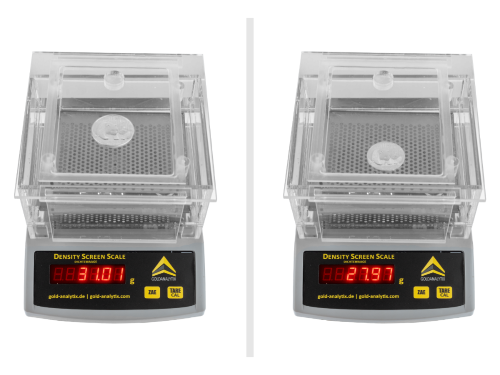
The specific weight or density of a metal such as silver can also provide information about the purity of the material and the nature of the objects interior. Counterfeits in which the core material differs from the density of silver or the silver alloy can be detected using a density scale. These include very common silver forgeries with a copper core. To do this, the object is weighed once outside the water (left) and once in the water (right) and the values entered into the Excel tool supplied. In addition, lead-containing silver objects can be uncovered and in rare cases those with cores made of other metals such as bismuth. The following overview compares the densities between silver and common counterfeit materials:
Metals with a density similar to pure silver:

Silver
Density: 10,49 g/cm3

Molybdenum
Density: 10,28 g/cm3

Lead
Density: 11,40 g/cm3

Bismuth
Density: 9,75 g/cm3

Copper
Density: 8,9 g/cm3
The particularly insidious counterfeits are those with a core of same density metals as the imitating precious metal. This type of forgery is now widely known, especially in the case of gold: the gold object (gold coin, gold bar or jewelry) is provided with a core made of tungsten. Since both have the same density (19.3 grams per cubic centimeter), the objects have exactly the same weight and dimensions. And contrary to the widespread opinion that this type of counterfeiting is not widespread for silver, lead-tin or molybdenum counterfeits have recently appeared particularly in Eastern Europe and increasingly also in Germany and Austria. We recently inspected a large number of almost perfectly counterfeit Russian silver coins. The embossing quality, as well as dimensions and weight, were almost identical to the originals. For this type of counterfeit, other test methods such as the GoldScreenSensor or the GoldScreenPen are required. For silver in particular, the eddy current measurement should be preferred to the magnetic measurement. Some counterfeits, such as the silver panda pictured above, treacherously have the same magnetic properties as silver. The conductance, on the other hand, cannot be imitated by counterfeit silver, because silver has the highest conductivity of all metals.
Eddy current measurement: a quick way to test silver
If the density measurment with the density scale or the determination of dimensions / weight has given a correct result, a large number of silver forgeries can be ruled out. The next step is to watch out for professional counterfeits with materials of the same specific weight.
So-called eddy current analyzers such as the GoldScreenSensor or the GoldScreenPen are a good choice here. The GoldScreenSensor is ideal for gold or silver coins. With their help, the inside of the coin can be examined non-destructively and very quickly. The foreign metal inclusions change the response behavior to the GoldScreenSensor even in small quantities. By applying an alternating magnetic field of a defined frequency, eddy currents are excited inside the coin and the measurement of these currents ultimately enables the distinction between real and fake silver.

Simple check of silver cutlery!
Silver cutlery is particularly popular with household liquidations or inheritances. However, there are big differences in the value of shiny silvery objects. Starting from real sterling silver with a silver content of 925/1000 pieces to silver-plated cutlery and almost worthless hotel silver: a correct analysis is crucial when purchasing and with the GoldScreenPen very feasible. In this way you can avoid unpleasant surprises and quickly assess the value of the cutlery. This video explains and demonstrates, in german only, the examination and differentiation of cutlery.
When testing silver cutlery you should watch out for the hallmarks ARG 800, AMZ 800 or Super Inox 800. These stamps pretend to be made of 800 silver, but mostly consist only of silver-plated stainless steel. These counterfeits can be quickly unmasked with the GoldScreenPen. On the right site you can find a link to a video for testing silver cutlery, but only in German.
