

Methods for testing gold
Numerous testing methods are available for the gold test. The optimal procedure depends, among other things, on the geometry, properties and gold content of the test objects. Depending on whether gold jewellery, gold bars, dental gold, gold nuggets or gold coins are to be tested, different methods can be used and combined. In the following 3 sections we will show you the correct procedure for checking the authenticity of gold bars, gold coins and gold jewellery. If you would like to find out more about the functionality and application of individual test methods, you can use the test method icons to access the respective test device. Our Coin Dimensions & Weights section is also very helpful for looking up measurements when checking coins.
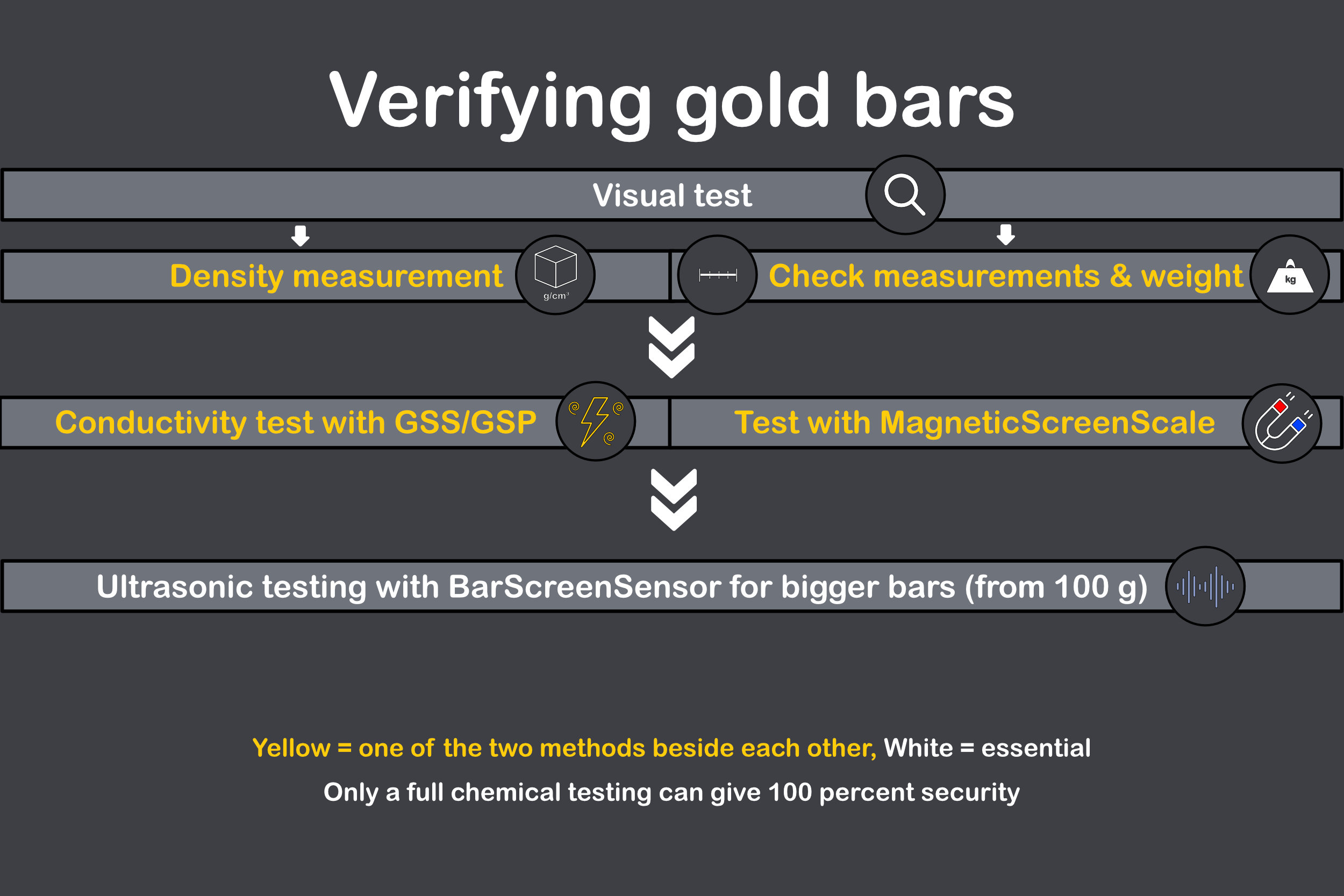
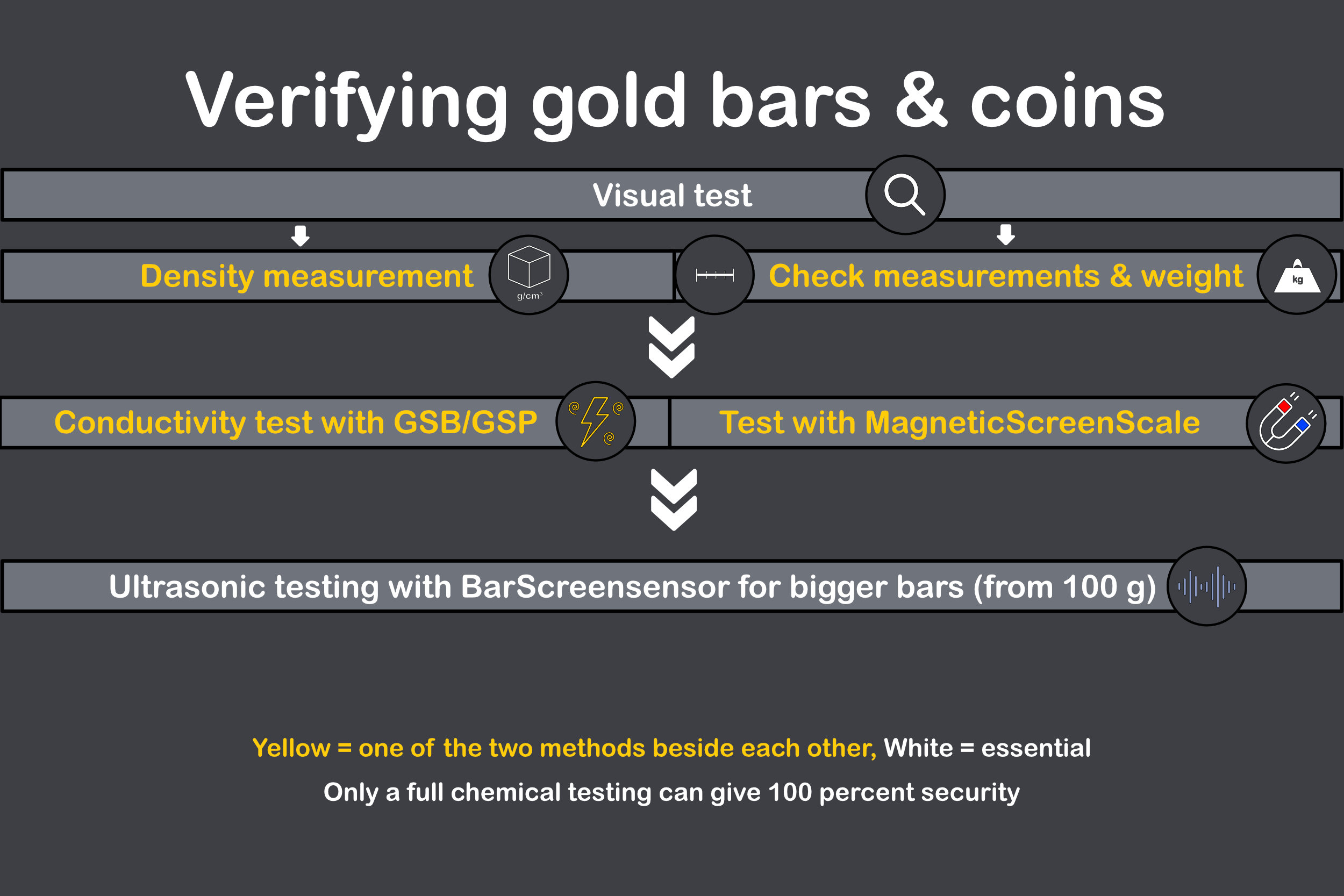
Despite the high accuracy of the gold testing devices, an important principle of gold testing remains in place: A single testing method can never identify all forgeries in a non-destructive manner. A combination of several methods (at least two, e.g. density and conductivity) is always advisable. The only method that can provide unequivocal information about the complete composition inside the precious metals is chemical digestion (dissolution in acid) and the following analysis. But this requires the bar to be destroyed - not ideal for the inclined precious metal investor!
Table of contents
- 1. Gold bar testing
- 1.1 Small bars up to about 1 ounce
- 1.1.1 Weight check
- 1.1.2 Dimensions check
- 1.1.3 Density check
- 1.1.4 Electrical eddy current measurement with the GoldScreenSensor or the GoldScreenPen
- 1.1.5 MagneticScreenScale
- 1.2 Large gold bars (from approx. 50 g)
- 1.2.1 Ultrasound scanning
- 2. Checking the authenticity of gold coins
- 2.1 Determining the weight & dimensions / Density test
- 2.2 Electrical eddy current measurement
- 2.3 MagneticScreenScale for coins
- 2.4 Superficial methods of determination
- 3. Checking gold jewellery
- 3.1 Counterfeits of gold jewellery
- 3.2 Particularities of gold jewellery alloys
- 3.3 Procedure for testing gold jewellery
- 3.3.1 Superficial examination with test acids or x-ray fluorescence analysis
- 3.3.2 Penetrating methods
1. Gold bar testing
In the first section, we will show you a suitable procedure for testing gold bars. Above all, the size of the bar and the packaging condition (with or without plastic wrapping or blister) play a role.
1.1 Small bars up to about 1 ounce
1.1.1 Weight check
In practice, many bars are packed in blisters with a certificate and serial number. In these cases it is often difficult to determine the correct weight of the pure metal without unpacking the bar. Nevertheless, you should check whether the weight is plausible or research the Internet in advance for suitable total weights. Many manufacturers give at least the approximate target weights for certain bar series. Often the result is extremely implausible, even with a blister pack - for example, a counterfeit 1 ounce bar that we examined a while ago looks good. The weight together with the blister was just 31.3 g - so the blister would only weigh 0.2 g, which of course cannot be. Therefore, this bar could quickly be identified as a forgery.
1.1.2 Dimensions check
If the object has successfully passed the first inspection, it is best to measure the correct dimensions with a digital caliper or a micrometer. For most bars and bar sizes, there are clear reference dimensions (available from the manufacturers' websites) with which they must match:

Perth-Mint: Korrekt

Zu dick (Original 1,7 mm!)


Im Toleranzbereich/Korrekt
Plastic packaging
In contrast to the weight, the dimensions can be determined almost exactly through the blister. Under certain circumstances, measurements can be made more precisely with a folding rule than with a caliper. Width and length can usually be precisely measured. When checking the thickness, it may be necessary to press a little into the packaging. Of course, the measurement inaccuracy increases the smaller the bars are.
Attention: If you have any doubts about its authenticity (optical deviations, potentially dubious source, astonishingly low price, etc.), we recommend that you unpack the bar and measure and weigh it precisely. This may not be ideal, but it is better than buying a fake!
The following images are fake (conductance for GoldScreenSensor: 14.5 instead of 45 MS/m). Weight, length and width are imitated very precisely. However, the thickness is far too high (approx. 4.6 mm instead of 1.75 mm), which can be clearly seen despite the blister:

Plausibel für eingeblisterten Barren

Zu dick (Original 1,75 mm!)


1.1.3 Density check
If the density or the "pseudo-density" (dimensions & weight) is correct, many types of counterfeiting can be ruled out. As a result, only alloys that have the same density as the respective precious metal come into question as counterfeit materials. The following comparison table shows which pure metals and alloys have densities similar to those of fine gold (of course, due to the large number of possible materials and potential new developments, this is not a completely complete list):
Metals with a density similar to gold 999:

Pure gold
Density: 19.3 g/cm3

Tungsten
Density: 19.25 g/cm3

Tungsten-Copper
Alloy (95/5)
Density: 18.5 - 18.9 g/cm3

Uranium
Density: 19.01 g/cm3

Silver-Iridium (AgIr)
Density: 17.0 - 19.1 g/cm3
1.1.4 Electrical eddy current measurement with the GoldScreenSensor or the GoldScreenPen
In order to non-destructively test small bars (up to approx. 50 g) for the presence of counterfeit materials of the same density, at least one additional test method is necessary. Eddy current measurement is an excellent way to see to a certain depth below the surface of such possible forgeries. With this method, it is possible to determine the electrical conductivity inside precious metals. The result of the conductance analysis is compared with the respective "target" values by the devices. If there are deviations here, there are clear indications of potential gold forgery. Fortunately, all counterfeit materials known to us with the same density have a conductivity that deviates from that of pure gold (specified in megasiemens per meter [MS/m]). Thus, these treacherous imitations (like e.g. those found in Cologne in 2022) can be identified with the Goldanalytix GoldScreenSensor or the GoldScreenPen. However, be sure to note the respective penetration depths in the different precious metals. Because it is only possible to determine deviations due to a foreign material up to just below these limits. In the case of silver, for example, the penetration depth is around 250 µm - this is a lot when you consider that most coatings are only 20 µm thick and therefore a large number of counterfeits up to around 1 ounce can be identified. In the case of larger objects such as a 100 gram or even 1 kilogram bar, however, it would be quite conceivable that the counterfeiters would apply thicker layers and therefore testing with the GoldScreenSensor or the GoldScreenPen alone would not be sufficient.
Very important:
There are also materials with a conductivity similar to that of fine gold. In this case the density is usually not identical to gold (of course we cannot completely rule out the possibility of such a case due to the further development of metallurgy and alloy science). Therefore, always remember: A stand-alone test method can never identify all counterfeits without being destroyed.
1.1.5 MagneticScreenScale
Another complementary method for measuring the bars is to determine the, so-called magnetic susceptibility properties, with the MagneticScreenScale. This method can check through blisters and packaging up to a certain thickness and determine whether the applied material has the correct magnetic behaviour (para- or diamagnetic). The magnetic balance is a purely qualitative process and a quantitative determination of the gold content is not possible. So you can check the presence of a potential foreign metal inclusion - that's why we often refer to the magnetic balance as a "tungsten detector". Because a gold bar, as a so-called diamagnet, displaces a magnetic field and counteracts it - this creates pressure on the measuring head and a positive value is displayed. If you put on a supposedly real fine gold bar and a negative value appears, something is usually "fishy". Please note that if the material, that is being counterfeited, is also a diamagnet, a positive value will also appear and detection of the counterfeit with the magnetic balance alone is impossible. Therefore the already mentioned principle of "multi-method" analyses applies. But it is precisely the treacherous forgeries with a tungsten core that can usually be recognized. The following graphic clearly illustrates this:
Diamagnetism

Magnetic flux lines are pushed out of the material. The object is repelled by the magnet. Result: positive (+) value on the MagneticScreenScale.
Paramagnetism

Magnetic flux lines are drawn into the material. The object is attracted by the magnet. Result: negative (−) value on the MagneticScreenScale.
1.2 Large gold bars (from approx. 50 g)
In principle, the same principles apply to determining the authenticity of bars from around 50/100 g as for smaller bars. First, one examines the weight, dimensions and ideally the density. Because, especially with larger objects, there are often no standardized standard dimensions and therefore density measurement is often unavoidable. Watch the test of a silver bar with the density scale in the following YouTube video (works in the same way for gold bars, target density is 19.3 g / cm³ for pure gold):
1.2.1 Ultrasound scanning
In contrast to the smaller bars, you should use the scanning of the propagation speed of the sound in the material for large gold bars with the BarScreenSensors. Because if a forger hides a tungsten core or something similar deeper inside a bar, the GoldScreenSensor or the GoldScreenPen may not get into these areas. Of course, you can still measure large objects with these devices. There are also many counterfeits in the range of 100, 250, 500 or 1000 gram bars with moderately thick gold coatings that are penetrated. In this way, it is estimated that 60 to 70% of the counterfeits in circulation can be discovered. The forgers want maximum profit and reduce the precious metal content to the bare minimum.
The analysis of the speed of sound propagation brings clarity and exposes these insidious forgeries. If, after determining the thickness of the bar, the determined speed of sound deviates from the target value, it is most likely that another material is included. This method can be used to gradually scan the entire bar. This is illustrated by the following graphic:

The method is not suitable for smaller objects (see point 1.1) because the path lengths for measuring the sound are too short, measurements through packaging and blister packs are not possible and the proportion of the embossing (i.e. the "air path") in the total path increases is great. However, due to the high financial values involved, removing the packaging should not prevent a thorough examination. Should a seller even try to prevent you from doing this, this could be an indication that increased caution is appropriate. Above all, make sure that you check the entire bar - sometimes the forgers only bring in one half of the counterfeit material in order to simulate authenticity with the other half in self-initiated tests.
Conclusion on the gold test for bars
In summary, it can be said that bars of all sizes, shapes and in a wide variety of packaging are now being counterfeited. The fake bars found in the process range from very clumsy forged, gold-coated iron, stainless steel or brass bars to counterfeit gold with tungsten cores. A detailed gold test according to the procedure described above is essential for these objects. Because unfortunately, it is the case that the buyer of such counterfeit gold bars is liable to prosecution (even unknowingly) and is subject to the burden of proof. If you still have doubts about the authenticity after the tests, then it is advisable to cut the bars or subject them to a chemical analysis.
2. Checking the authenticity of gold coins
This section is dedicated to the appropriate procedure for checking the authenticity of gold coins of various sizes. Since, in contrast to the bars, alloys with different gold contents also play a role for the coins, we also consider those. A 900 gold alloy is understood to mean, for example, a mixture of 900 parts (or, in other words, 90%) gold and 100 parts or 10% of another metal or metal mixture. The most common compositions in the coin sector are gold-copper or gold-copper-silver mixtures. Occasionally, especially in South America, larger gold-silver stamping series are also coming onto the market. Also note that some mints have changed the composition of their coins over time. For example, the UK Britannia, in the first 3 years of its minting (1987-1989), had a composition of 91.6% gold and 8.84% copper, which from 1989 onwards was 91.6% gold and 4.42% copper and 4.42% silver was changed and finally switched to 999 pure gold in 2013. However, this is more of an exception, in most cases, the mints have kept their usual composition for decades. However, it is important to keep this possibility in mind, as otherwise wrong conclusions can be drawn.
Furthermore, a distinction must be made between more recent coins (roughly defined as the period after the Second World War) and coins before 1945 and above all from the 18th and 19th centuries. The older coins in particular were often still covered with a lot of impurities and undesirable foreign inclusions. The following is a consideration of the testing process of the currently most common and by far the most traded, so called Bullion investment coins. The best-known representatives are likely to be the Krugerrand, the Maple Leaf, the Vienna Philharmonic, the UK Britannia, the various Australian gold coins (such as the Kangaroo or the Lunar series) and the Chinese panda series. In the following, we will mention the special aspects that have to be taken into account with older coins.
2.1. Determining weight and dimensions / density test
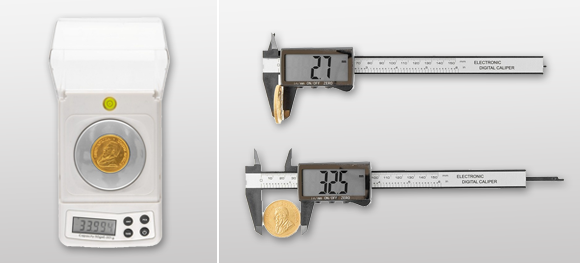
In the case of coins, it is usually easier to determine the correct reference dimensions and to compare them with the coin in question than with bars. The weight is defined by the mostly clear classification into the sizes 1/10 ounce, 1/4 ounce, 1/2 ounce and 1 ounce. Note that with alloyed coins such as the 1-ounce Krugerrand coin, the fine gold content is equivalent to 1 ounce (i.e. 31.1 g), but the total weight is higher due to the addition of copper or copper / silver (to increase scratch resistance) lies (e.g. with the Krugerrand 33.95 g) - you should be careful not to get confused by the names - the ounce actually always refers to the actual fine gold content.
A comprehensive and very detailed overview of the precious metal coins sorted by country with weights and measurements can be found in our dimensions section or in the coin catalogue of the ESG-Scheideanstalt (in German). You can determine the weight with the Goldanalytix precision balance and determine the dimensions with the digital caliper. Especially with irregularly shaped coins, if no reference values are available or if the embossing is particularly deep (and therefore the thickness value is not meaningful), you should use the DensityScreenScale to check the coins for the correct specific weight. This method allows you to measure the specific weight of precious metals and to compare it with corresponding reference values. The testing of an ingot (works the same way for coins) can be viewed here, in our DensityScreenScale YouTube video.
If the dimensions and weight or density are almost the same, there can only be one material that correctly imitates these properties. Please refer to the table in section 1.1.3. For example, there are a lot of coins in circulation that hide a core made of tungsten, tantalum or a tungsten alloy under a gold coating. For this reason, the test process must by no means be stopped at this point.

2.2 Electrical eddy current measurement
With the devices for determining the electrical conductivity inside (alleged) precious metal objects, Goldanalytix offers you the opportunity to identify dangerous counterfeit tungsten coins, among other things. Various of these eddy current induction devices are available for the respective application situations.
GoldScreenSensor
The GoldScreenSensor allows you to measure coins and bars (and other objects that can be laid flat) from a size of around 1 g for gold bars and from 1/10 ounce for coins. The trick is that the measurement also works through capsules, blisters and numerous other plastic packagings. It is important to know that the GoldScreenSensor has a different depth of penetration depending on the conductivity of the measured material. In the case of silver (the metal with the highest electrical conductivity), this is the lowest at around 250 µm, whereas the penetration depth for pure gold (around 300 µm) and gold alloys (around 700 µm) are significantly higher. These penetration depths also determine the object size or weight up to which the GoldScreenSensor can measure. Because depending on the geometry and dimensions of the object, the penetration depth can reach e.g. 0.5 mm to ensure that there are no foreign metal inclusions inside. This means a fake coin with one ounce gets detected, whereas a fake bar with 250 g is not detected. The following illustration illustrates this situation again:
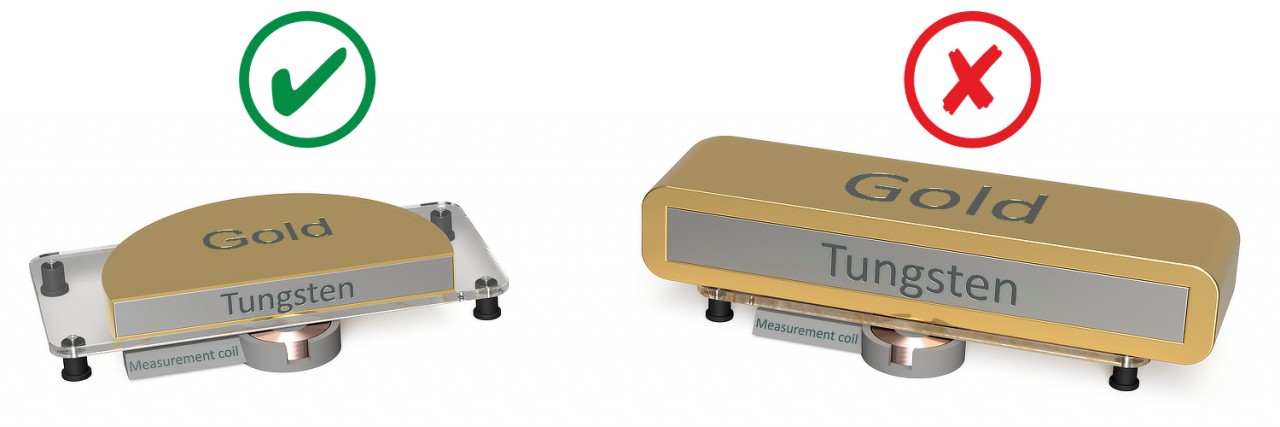
As can be seen in the illustration, the objects can have the same weight and volume, but different geometric arrangement results in completely different starting positions. It is therefore difficult to give a general assessment of the maximum measurable object size - for example, a thin gold ribbon (often manufactured as a preliminary stage for gold leaf production) can weigh several kilograms and is still easily measurable with the GoldScreenSensor. However, it can roughly be said that the GoldScreenSensor is ideally used in the range from 1 to 31.1 g. Of course, larger objects can also be checked, but always taking into account the restrictions described above. A large part of the counterfeits that we know of are in fact made in such a way that they are only covered by a thin coating of the respective material and can thus be recognized.
2.3 MagneticScreenScale
The testing of gold coins with the MagneticScreenScale is similar to the testing of gold bars, however, certain special points must be observed when using the coin test. The same applies here - a negative value for a modern pure gold coin (Maple Leaf, Philharmonic) is actually always a reason for closer examination of the coin. With the older pure gold coins and alloyed coins, things are a little different: unfortunately, it is the case that some coins and certain years were supposedly unclean or that ferromagnetic additives were deliberately mixed into the coins (as filler material or simply as alloy component considered necessary). As a result, coins that are actually flawless (i.e. correct gold content) show a negative value on the magnetic balance. For example, this is particularly common among the older Krugerrands of the late 1960s and 70s. In these cases, the gold content is okay, but in addition to the remaining copper, it also contains tiny amounts of iron or nickel. This leads to negative values on the scale (because a ferromagnet interacts particularly strongly with the magnetic field of the scale). We were able to observe something similar, for example, with Vrenelis' made in 1922. A superficial XRF determination confirmed that the gold content was as desired at 90%, but the measurement also revealed 0.2% iron content (unusually high).
Please note that with such a high proportion of ferromagnetic material, even the GoldScreenSensor or GoldScreenPen conductivity determinations are significantly lower than expected. It is very difficult to estimate how many coins or years are affected. We can therefore only reproduce some of our own observations and feedback from our partners in the gold refinery sector: in any case, the more specimens are "affected", the older the coins are. The problem is obvious, especially with very old coins from the 18th and 19th centuries. The entire process from extraction to purification and finally processing the precious metals did not come close to meeting modern standards. It was therefore not uncommon for numerous contaminants to be "dragged" into the coins and thus the corresponding measured values could also be impaired. With modern bullion coins, the phenomenon only occurs in exceptional cases (as described above with the Krugerrands. This means that you should assume that the typical investment gold coins of more recent minting are counterfeited if there are any deviations.
2.4 Superficial methods of determination
For the superficial methods, the most important of which are taking samples with the gold test acids and the X-ray fluorescence analysis (XRF analysis), that can also be used for coin testing. Very important: these methods are completely unsuitable for the non-destructive testing of forgeries with a foreign metal core! Because the XRF analysis only extends a few micrometers (µm) into the material and for a more in-depth examination with the test acids one would have to file or cut open the object at one point.
Both methods can, however, provide important clues to uncover possible under alloyings. Because a common type of forgery is the coin production of significantly lower-quality alloys than actually intended - for example, the Krugerrand is often made with 750 gold instead of 916 gold or the Vreneli with only 585 gold alloy instead of 900 gold. These coins could also be detected with an acid test - with the significantly more expensive XRF method, even the exact surface composition can be determined.
Conclusion on testing gold coins
The investment gold coins (so-called bullions), for example the Krugerrand, are by far the most common form of investment in physical precious metals for small investors. This is why most forgeries are found in the 1-ounce bullion coins (exact numbers on this are not available, the information is based on our own experience with uncovered incidents of counterfeiting among customers, etc.). It is important to proceed exactly according to the scheme mentioned, in order to uncover all types of counterfeiting (according to the current status; counterfeits are also developing!). The use of modern test devices such as the GoldScreenSensor is essential. With such methods, the gold coins can be examined non-destructively. Checking with the magnetic balance can always represent an additional penetrating method, taking into account the mentioned restrictions with older coins. The superficial test methods are also an advisable complementary method for further indicators of alloy fraud. At this point, it is very important to mention: do not underestimate the value of the density scale for the gold test. In the customer consultation process, we often get the fear that the density scale is a bit too clumsy or that the measurements are too lengthy for the purchase situation. This may be correct in comparison to devices such as the GoldScreenSensor - you do not get the result in the blink of an eye. But with a little practice and getting used to it, an analysis with the density scale can be accomplished in an average of 10 to 15 s. Secondly, it is usually not necessary to examine all objects in such depth, since many forgeries can be "sifted out" beforehand. And thirdly: the additional information gained, especially for differentiating between gold alloys in the coin and jewelry area (see much more on this below in Chapter 3) is extremely valuable.
3. Checking gold jewellery
The authenticity check of gold jewelry in its entirety presents a great challenge. Due to the very diverse geometries (rings, fine and coarse-linked chains, earrings, etc.) and texture (differently mixed (color) gold alloys with different carat numbers), it is impossible to always propose the same applicable testing method.
Therefore, in the subsequent section, we will give you some basic guidelines and recommendations for jewellery testing and show you how to best proceed using selected test scenarios.
3.1 Counterfeit gold jewellery
Firstly, we will give you an overview of the most common types of counterfeit jewelry.
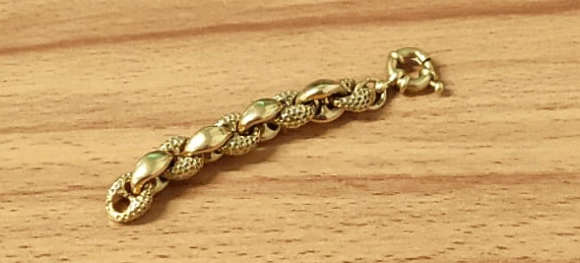
1.) In the first case, the coating of a base metal with gold indicates that it is a valuable object. Some examples are the common rings, chains and pendants made of tungsten or tungsten carbide. These materials almost perfectly imitate the density and thus the "feeling of heaviness" or feel (grip or tactile perception) of gold and gold alloys. This leads to the assumption that you are holding high-quality gold in your hand, but it is just a more or less thick coating of gold. A common variant of this is "fake gold" - often times cheap or stainless steel is coated in gold and sold as real gold jewelry. The name comes from the jewelry pieces that are often offered "by chance" very cheaply at motorway parking lots under the pretext of the fraudsters that they urgently need money for their onward journey or similar stories.
2.) Underlay / stamp fraud: an alloy with less gold content than is specified by the stamp or hallmark is present. This can be observed very often with 585 wedding rings: 585 or 14 carats are stamped on, but in reality there is only a 385 or 333 alloy (similar to the other alloys). Here the profit of the counterfeiters lies primarily in the mass of the manufactured objects and the not so obvious recognizability of the forgery. After all, you have almost the right alloy in your hand, but you still pay a not inconsiderable "premium".
3.) As in point 2, but even more refined - the right alloy is galvanized on the surface (e.g. approx. 585 red gold) but underneath, there is either only worthless foreign metal, as in point 1, or an inferior alloy, as in point 2. This second type of counterfeit in particular has its pitfalls when it comes to detection - see section 3.3 below.

3.2. Particularities of jewellery gold alloys
The case for bars is pretty clear - the vast majority of all bars are made of pure gold 999 or 9999. The gold coins, especially with the most traded investment coins, are either made of pure gold 9999 (e.g. Maple Leaf or Philharmonic Orchestra) or mostly clearly defined alloys made of gold-copper (e.g. the Krugerrand coin made of 916 parts gold and 84 parts copper), gold-silver or gold-copper-silver (UK Britannia years 1990 to 2012 or the American Eagle) with proportions of 900 to 986 parts gold.
The situation is completely different with jewellery gold alloys. There are 2 main problems for the authenticity check:
a.) With gold contents below 800 parts of gold, the conductance values of the respective gold alloys move even closer together or the relationships between precious metal and copper or silver are reversed and the conductance values sometimes rise again. This is a problem especially for penetrating eddy current measurements and makes it difficult to interpret the results with this method. If you look at a conductivity table of, for example, red gold alloys, you can see that small additions of foreign metal to the gold still cause major changes in conductivity. However, this increasingly changes as the proportion of foreign metal increases. If the copper content increases, the development of the conductance is reversed and increases, so that certain mixtures automatically overlap.
b.) One recognizes that completely pure red gold alloys could be determined by means of penetrating conductivity measurement, but there is still a practical problem: the alloys in the jewelry sector are usually not simply binary (mixture of 2 components) mixtures. The 585 red gold alloy from one manufacturer may have a significantly different composition than the 585 alloy from another manufacturer. It is possible for manufacturer 1 to add completely different metals to the gold than manufacturer 2 for the purpose of optimizing gloss or hardness (for example, cadmium, nickel, copper, silver or palladium can be added to the gold in different amounts). This means that the final piece of jewellery has the same gold content and is then stamped accordingly, but the final mixture has completely different properties in terms of conductivity, density and other physical measurements.
Due to these two problems, it can happen that 2 pieces of jewelry are sold as 333 red gold, but sometimes differ significantly in their conductance or even in their density, since the final mixture in both cases is 333 parts (always based on 1000 parts) gold, but the remaining 667 parts have a different composition. Very important to know:in both cases, our test devices provide you with the correct conductance, magnet weight or the density of the respective mixture, but as you can see, the interpretation of the result is not always easy in these cases. This often requires a lot of experience or corresponding data from the manufacturer on the exact composition.
3.3 Procedure for testing jewellery gold
3.3.1 Superficial examination with test acids or X-ray fluorescence analysis
Since there are usually no clearly defined reference weights and dimensions for pieces of jewellery, a weight check is usually only advisable when it comes to imitations of known pieces or series. In this case, you can compare the weights with the information provided by the original manufacturer. Due to the great diversity and individual providers, it is generally rather difficult to get reliable comparative values without too much effort. Nevertheless, it is of course worthwhile to compare the supposed target weight (e.g. from the information on an enclosed certificate) with the actual weight.
.
The first step, which is relatively easy to carry out and inexpensive, normally is the examination using a gold coating test and gold test acids. Briefly explained, when doing a random test, the surface of the golden test piece is rubbed off on a so-called test stone (usually made of special slate). Depending on the test situation, different test acids are then applied to this abrasion in order to determine the carat number. For more in-depth details on how to carry out the test acid method, please refer to our page on the use of test acids. Note that the test acid method is not entirely non-destructive, because you always leave a small scratch on the abrasion point. This means that the method is not suitable for newer and representative objects, but it is for old and broken gold. In the case of old gold, it may be possible to file the objects deeper or even cut them open and then remove the abrasion from the inside. In this case, the test acid methodology changes from a superficial to a quasi-penetrating methodology. Of course, this procedure is significantly more complex and time-consuming than other test methods, but in some cases, it is actually the best option. Another superficial method that provides clearly detailed information on the surface composition is X-ray fluorescence analysis (XRF analysis). The exact elemental composition on the surface can be determined here. However, the method is relatively expensive (from around € 15,000 for portable devices to € 45,000 for high-end table-top devices) and, above all, a very important point that has to be observed and which often causes confusion and misinterpretation: the XRF method is a purely superficial method - the penetration depths in gold are only a few micrometers (µm)! This means that only extremely thin gold plating (so-called decorative or flash gold plating) can be penetrated. The hard gold plating (mostly defined as layers with a thickness of 20 µm or more) can not be penetrated. If you now consider that most of the tungsten copper or tungsten forgeries mostly have gold plating between 30 and 60 µm, it becomes clear that the XRF method can lead to dangerous misconceptions here. In the event that the objects can be filed or cut open, the same statements apply as for the test acids.
With both methods, you can roughly determine the carat number on the surface of the objects and compare it with the stamped (supposed) gold content. Many objects can usually be sifted after this step. At this point in time, nothing is known about the composition inside (unless, as mentioned, the objects can be cut open or filed). It is therefore necessary to carry out further investigations with non-destructive but nevertheless penetrating methods.
3.3.2 Penetrating methods
First of all, a distinction must be made between objects that are made uniformly from a precious metal or a precious metal alloy and those that are made either from several (coloured) alloys (so-called bi-colour or tri-colour pieces of jewellery, e.g. with parts made of yellow gold or red gold or white gold) or with permanently installed stones, hollow spaces or other foreign materials. In the 2nd case (i.e. non-homogeneous or uniform pieces), the determination using the density scale can not be used.
However, if there are pieces of jewellery made from one material and without cavities (e.g. wedding rings made of 585 gold, chains without gemstones, watch cases, etc.), their specific weight can be determined by measuring the density. The densities of the various jewellery gold alloys can usually be easily differentiated from one another (with the exception of "exotic" compositions, e.g. high platinum or iridium content).
At this point there are two crucial questions:
a) How do you deal with counterfeit jewellery that imitate the density of the original alloy?
b) How do you deal with under-alloys in objects that are not massive and homogeneous and therefore not accessible for density measurement?
First of all, it should be said that there is no perfect procedure for both problems to identify every conceivable forgery.
There is usually a very good problem solution for the objects described in the first question a): GoldScreenPen. If you have already clarified the density in a previous step, it is advisable to follow up with a measurement with the GoldScreenPen. Due to the fine measuring tip and the inductive-penetrating measuring method, it is possible to detect cases of coated foreign metal bodies even on pieces of jewelry. For as long as the contact surface on the object corresponds at least to the size of the measuring tip, the object can be examined with the GoldScreenPen up to the penetration depth of the respective precious metal. That means for cases like gold-plated tungsten carbide rings or the fake gold (mostly gold-plated stainless steel chains etc.), that this method works very well.
Important to know for question b): for alloys that have less than 900 gold content, the conductance values move closer and closer together and from a certain amount of, e.g. copper, the values even increase again. This means that there is a lot of overlap and therefore some identical values for different (colour) alloys. As a result, when trying to determine the carat numbers on the inside with the GoldScreenPen, a good knowledge of the respective conductance values and a certain amount of experience is required. Knowing the exact composition specifications of the manufacturer is also helpful. Because in the field of jewelry alloys, there are many additives to gold alloys, for example to modify the hardness, the luster or the color. However, every addition of metal also means a more or less large change in the electrical conductivity of the object.
It is essential to note the following: The GoldScreenPen will give you the correct conductance of all measurable objects up to the respective penetration depth! Only the interpretation of this result is a lot more difficult in the field of jewellery alloys than in the case of coins or bars because it can happen that a 585 red gold alloy is in a similar range as a certain 333 white gold alloy. Due to these imponderables, it is recommended in any case, before testing with the pen, to verify at least the carat content that is stamped with the test acids (if available, preferably with XRF). This is because the differentiation between alloys with the same gold content is much easier. Because white gold can be clearly distinguished from red gold and yellow gold and the possible conductance values are reduced to one (white gold) or 2 (either yellow or red gold) - this makes the evaluation of the results much easier.
Conclusion on testing gold jewellery
Due to the large number of different types of alloys and object geometries, the inspection of jewelry is more demanding than that of bars and coins. However, many forgeries can already be identified with superficial methods or the density scales. In combination with the methods from above, the GoldScreenPen can also provide decisive indicators for identifying counterfeits. Please note that the MagneticScreenScale, the BarScreenSensor and the GoldScreenSensor are generally not suitable for checking jewellery (apart from a few exceptions, e.g. watch lids or similar).